
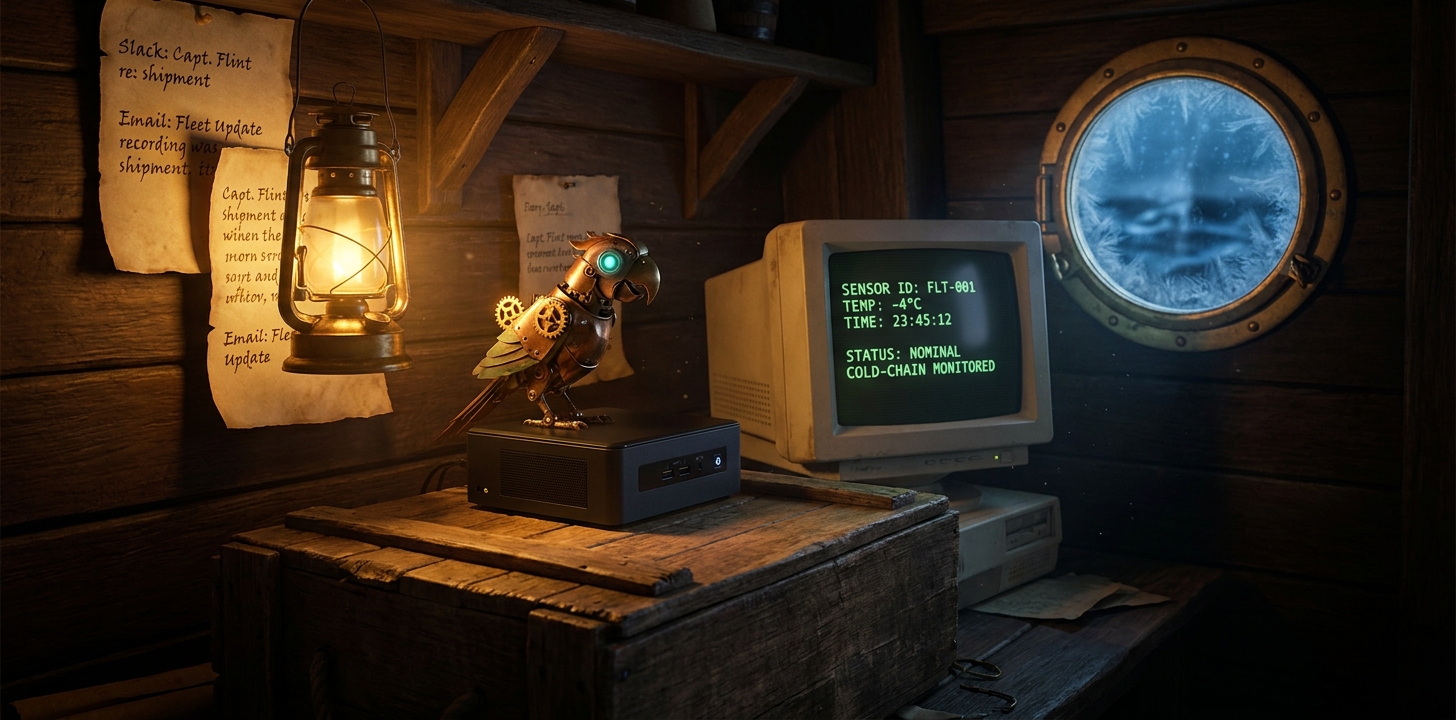
Humi Assistant is deployed on a dedicated machine at the client's site, monitoring ~1,040 cold-chain sensors around the clock. One profile. Six custom skills. Fleet intelligence delivered through Slack and email.
Humi Goes Live
The client monitors refrigeration fleets — walk-in freezers, coolers, compressors. About 1,040 sensor units streaming temperature and performance data into a MySQL database on AWS RDS. A custom analytics engine runs eight algorithms plus ARIMA forecasting against that data nightly, scoring every sensor for drift and failure risk.
The developer's job was to put an agent on top of it. Something that monitors the fleet, answers questions, generates reports, and works proactively on a schedule. The result is Humi Assistant, running on a dedicated BOSGAME P6 mini PC plugged into the client's network.
The profile
A single Hermes profile handles everything. Slack is the gateway. Fleet alerts land in the operations channel. The team can ask questions in plain language and get back sensor data, anomaly summaries, or formatted reports without touching a dashboard.
Memory is enabled with a 1,000-character cap. The profile knows the client's communication preferences, team terminology, and how anomalies should be described in customer-facing email. It does not store sensor readings or routing rules — those belong in MySQL and documents, where they can be queried precisely and updated without touching the bot.
The skills
Six custom skills were built for this deployment.
mysql — read-only RDS connector. A dedicated read-only user has SELECT access and nothing else. All sensor data queries, account lookups, and fleet summaries go through this skill.
send-mail — HTML email composition with embedded matplotlib charts. Resolves Slack profile emails automatically before sending. Delivers via the agent's Gmail account through Google Workspace API.
critical-sensor-deep-dive — production-grade HTML email reports for flagged sensors. Pulls 14 days of temperature readings, runs SARIMA forecasting, writes a per-sensor assessment narrative, and delivers it as a fully formatted email to the relevant contacts.
research-documentation — saves completed research as dated markdown files to ~/Documents/research/. Work stays persistent without consuming memory.
technology-research — deep-dive research on vendor technology stacks, product ecosystems, and cross-referenced sourcing. Used for equipment evaluation and client-facing technical summaries.
platform-diagnostics — troubleshoots Slack delivery failures. Scopes, file upload paths, gateway issues.
Cron
Fleet monitoring fires every four hours. The job queries sensor data, runs anomaly detection against the analytics engine scores, and posts alerts to the operations Slack channel without a human trigger.
A separate email-checker runs every thirty minutes. It reads the agent's inbox and posts a summary to Slack when new messages arrive.
Hardware
BOSGAME P6 mini PC. Ryzen 9 6900HX, 32GB LPDDR5X, 1TB NVMe. One-time cost of $559. Runs Linux, hosts the Hermes profile, connects to the client's local network. The analytics engine stays on its existing infrastructure. Humi reads from the same MySQL database the analytics engine writes to — no data duplication, no cloud compute costs for report generation. API credits are the only recurring cost: roughly $10 to $20 a month.
What's running
Humi Assistant is live. The fleet cron fires on schedule, the email-checker has completed thirty-five runs since deployment, and critical sensor reports are going out as HTML email to clients. The agent answers questions in Slack, generates reports on demand, and monitors the fleet whether or not anyone is watching.
One machine. One profile. Full fleet.